Ads from a bygone era

It is fascinating to me to read old magazines from the 50s and 60s and look at the way our advertising world has changed. I suppose this could apply to television ads as well. I think the drastic change in our advertising completely shows how our world is different now and what the “powers that be” have decided we need in our lives. Think about it: when’s the last time you have seen an ad for . . .

. . . shower curtains? Now, this ad did send me down a bit of a rabbit hole because I had never heard of Kleinert’s before. This from their website:

Isaak B. Kleinert founded Kleinert’s, Inc. in 1869 in College Point, NY, initially known as I.B. Kleinert’s Rubber Company. As an innovative inventor, Kleinert created many enduring products like the shower cap, shower curtain, dress shield, and waterproof baby pants. By the mid-20th century, Kleinert’s had become an international manufacturing powerhouse, supplying rubber life rafts to the US Air Force during WWII.

From the 1970s to the 1990s, Kleinert’s expanded its product line to include children’s clothing, footwear, and personal protection products. Embracing e-commerce in the mid-1990s, Kleinert’s launched its first website and grew its direct-to-consumer business.

Since 2003, Kleinert’s, now headquartered in Elba, Alabama, has been a leading manufacturer of products for excessive sweating and incontinence. We proudly produce all our goods in the USA, supporting local jobs. Our customers include Disney, Broadway shows, military academies, and more.

We continually innovate, offering advanced products like Fabrapel-treated fabrics and Sweat Shield Ultra wipes for hyperhidrosis. Kleinert’s remains committed to enhancing lives and extending the longevity of clothing.

The more you know, I guess.

Continuing . . .

When’s the last time you saw an ad for . . .

. . . good ol’ regular curtains? These, of course, are quite prevalent in magazines such as Better Homes and Gardens from the Midcentury. Heck, you could even get a free curtain booklet.

Now, tell me . . . When’s the last time you saw an ad for . . .

Fake stick-on tile? That color rocks my world, by the way. It is always the color I am drawn to when I am buying vintage items. The picture is great as well. He pauses mid-installation to look back at his ecstatic wife in her apron and oddly maniacal expression. Obviously, this was a marriage that worked — for whatever reason.

Oh – notice the “Magic Congowall show” advertised on the inset text? Why does that sound like something I’d like to attend?

When’s the last time you saw an ad for . . .

. . . refrigerators made by tractor companies? (I apologize for the non-straight scan here; this ad came out of a bound book full of Better Homes and Gardens magazines from 1950 and it’s pretty huge; it is impossible to straighten the pages enough to get a straight copy.) I had never seen this company name attributed to appliances until I ran across this ad; I only knew it as a company that made farm equipment. However, Google informed me that IH did venture into the appliance manufacturing sector from 1947-1955, and then they sold out to Whirlpool. I love the totally sexist “femineered” sales pitch and the “Egg-O-Mat” storage option. “Diffuse-O-Lite” as well. Just so 50s and so fun. At some point they would offer colored door handles to match your color-coordinated kitchen:

(Note that they were really set on the “femineered” sales pitch.)

I do miss how one could get appliances to match their kitchen. Now we have white, black, stainless, black stainless, gray, dark gray, light gray, medium gray . . .

I jest, but the color options are severely lacking.

IH also gave housewives a great idea — or should that be “great” idea? Cover your fridge with fabric to match your kitchen!

I notice the third line touts a “door pedal” . . . for what? Why doesn’t my fridge come with a door pedal??

Even more interesting is the text at the waaaaaaaaay bottom, which says that IH was based at 180 N. Michigan Avenue in Chicago. I now work just a few blocks from there. Here’s the building after its completion in 1937:

And here is the building today:

And, finally . . . when’s the last time you saw an ad for . . .

. . . a TV with a 19 1/2″ screen — or just a TV in general?

I think manufacturers have just assumed that we are going to go to Wal-mart hunting for the best and the biggest TV we can find.

Back then a TV was part of your household; it wasn’t going to be replaced every other year. It sat like a rock in your living room because after it got wrangled into your house, you were too old and tired to wrangle it back out.

My husband and I grumble while watching our TV provider – Hulu – because it seems like every freaking commercial is either Burger King (with that ultra-annoying off-pitch singing) or an ad for a drug company. Look at the ads in modern magazines; modern medicine has a firm hold on our advertising, and I don’t see that changing anytime soon.

Bring back the ads for curtains and stick-on fake tile. If I have to watch one more time the Wegovy group inexplicably walking down the street like a pack of zombies, I just might be shooting the TV, Elvis-style.

Of course, if this were 1950 and my TV weighed as much as a refrigerator, I would have to think very, very carefully before taking such drastic action because then I’d have to get it out of my house.

Chalk another point up for 1950’s design right there.

Share

The Psychology Behind Car Ads

Back in my teaching days, I would always look forward to teaching one particular lesson about connotative and denotative meanings of words. While the subject itself is rather dull, I taught the concept through the topic of car design. Why did Ford decide to use the name Fusion? Why does a Chevy Malibu sound like fun to drive? Why does a Dodge Hellcat appeal to a select group of people? Even more fascinating is the psychology behind crafting the car ad. I always had a selection of ads to show my students and we would discuss what the target audience was for the ad, along with the connotative meaning behind the name.

In 1955, Ford employed poet Marianne Moore to help them come up with a name for their hot new product, which ended up being the notoriously unsuccessful Edsel. However, Marianne had submitted several suggestions, with some of them being just completely ridiculous. Here are some of her suggestions:

Hurricane Accipter (hawk)
The Impeccable
Symmechromatic
Thunderblender
The Resilient Bullet
Intelligent Bullet
Bullet Cloisoné
Bullet Lavolta
The Intelligent Whale
The Ford Fabergé (That there is also a perfume Fabergé seems to me to do no harm, for here allusion is to the original silversmith)
The Arc-en-Ciel (the rainbow)
Arcenciel
Mongoose Civique
Anticipator
Regna Racer (couronne a couronne) sovereign to sovereign
Aeroterre
Fée Rapide (Aerofee, Aero Faire, Fee Aiglette, Magi-faire) Comme Il Faire

After looking at her list of names, you might feel the way Ford Motor Co. felt when they kept getting these rather strange suggestions thrown their way. In the end, Ford ended up using the Edsel name, and the rest is history.

This story is often used to show how some executives can be completely tone-deaf when it comes to marketing and understanding what people want in a product. However, reading these letters and that story in general is how I became rather fascinated by the psychology behind marketing.

By the way, you can purchase the book that Marianne Moore ended up putting together of her letters between her and Ford Motor Co. It is called Letters from and to the Ford Motor Company.

I once was part of a focus group when I was just out of college. I had a friend who took part in focus groups often as a way to make money, and she convinced me it was very little work for decent pay, so I signed up for one. We were tasked with discussing the renaming of a local hospital, and the whole process took about four hours. We had to listen to their vision for the rebranding, we had very lengthy discussions about different names. I don’t remember all of them, but I remember one of them being Heartland and another being Crossroads as alternatives to the name they did go with, which was Avera. Ironically, that was the name I liked least of the four they presented us because I thought the name sounded like aloe vera, which I guess was probably part of the point. Healing vibes, right?

And now when new car models come out, I think about all the thought and energy that went into that name. It’s got to be getting tougher to name cars these days because – let’s face it – all the good ones have already been taken. Thunderbird . . . Rocket . . . Mustang . . . Falcon . . . Puma . . . names that evoke speed and power were some of the first ones to be used. And we have a Montana, a Colorado, a Santa Fe, a Durango, a Tucson, a New Yorker, a Dakota, and several other place names that are already taken, so obviously car companies are going to have to get more and more creative as time goes on.

My favorite part of the car lesson was the end, where students would be turned loose to design an ad around a fictional car, the name carefully chosen for its connotative meaning. I love seeing the creative names they’d come up with; however, every year there was always a jokester or two that tried to slip something rather inappropriate by me and I always had to give a stern lecture at the start of the project: be appropriate or you’ll be doing it over. I remember getting a car design that was entitled “The Milf.” One was called the “Shaggin’ Wagon.” Many teenage boys tried to work the number 420 or 69 into their model name. But overall, the majority of the names were fun and they made me laugh.

That’s not to say that the real car companies didn’t try to inject a little sexual connotation into their advertising. Behold, the series of 1968 Dodge Toronado ads that liked to recycle the phrase “bold, brawny, and massively male” throughout the texts of the ad series.

I mean, they weren’t even TRYING to market this car to women.

Some other gems:

So not only are they pretty much claiming that their car is as fast as a plane, but they are also claiming it is aerodynamic. Uh . . . I beg to differ. Look at what the inset picture is bragging about: push-button driving! The fifties were so fantastic for this reason.

I always loved this ad because of the incongruity of the picture. The kids are already playing in the water, dad is getting the floaties out of the trunk, but mom just sits there, so in love with her new red Chevy that she doesn’t even want to get out of the car. This was great marketing to women – the color, the perfect family image (always one boy and one girl), and a mom who has been entrusted to drive the car. Bravo, Chevy!

This ad has A LOT going on, and it’s an older ad from 1937, hence all the text. Ads now have little to no text because they know that we’re too busy to read anything. This one’s like a novella. First, the picture. What . . . is . . . happening? Woman driving, which I think is interesting for the year. She is obviously living out some cowboy fantasy here as her car flies over the hills on a ranch somewhere. The best part is the panel of “experts” that Chrysler has picked to offer choice words about their product. We have Lady Mendl, a designer and stylist; Tony Sarg, an illustrator and author; Irene Hayes, a florist; and Isabella Taves Miller, a fashion promotion editor. Why wouldn’t you trust the opinions of such high society?

It’s easy to get lost in some of these old ads, but if you have some hours to kill, check out this site, which has TONS of old ads scanned in that you can search by make, model, and year.

Even after teaching this lesson for 20+ years, I still could not figure out the justification for calling a car a Gremlin. Small and fast, I get it, but do you really want to market yourself as a small, quick, and UGLY product?

Discuss. 🙂

Share

Hindsight is 20/20 on Future Plans

A picture of my coffee this morning . . . because why not?

Eight weeks from today, my youngest son turns 18. The very next day, he graduates from high school. The day after that, I will officially be an empty nester; I already have plans to pack up all his stuff in extra large Hefty bags and leave them outside the door, along with a McDonald’s coupon for a small Shamrock Shake as an extra special treat.

Of course, it will be May and Mickie D’s will no longer offer the Shamrock Shake, but it is the thought that counts, and he’ll understand that.

I’m kidding, of course. My plans with Youngest Son are still evolving, as his ideas of what to do for college and a long-term outlook have been rather murky. If he had to take a quiz over his future plans, I have a feeling that a lot of answers would be the famous “IDK” (I don’t know). My only hope is that none of those answers would be the irritating “IDC” (I don’t care). As a teacher, I see plenty of both those answers.

Honestly, I know very few people who knew exactly what they wanted to do out of high school. I mean, we thought we knew, but we really didn’t. When I had to take an interest survey at 15, I was obsessed with Elvis. I loved playing music on my keyboard and dreamed of being a singer someday. Y’know – just like Elvis.

There was one problem: I was an introvert, and the thought of standing on a stage, singing and being vulnerable, made me want to vomit. (I did it once as a senior, as all seniors who got a superior rating on their vocal solo had to. I sang the shortest solo out of anyone and got the heck off the stage before I passed out. Here is the proof.)

However, having that idea in the back of my head, I answered all the questions correctly so that my #1 field ended up being in “entertainment and the performing arts.” It soon dawned on me that my reluctance to perform in front of other people might be problematic for a career such as this.

Back to the drawing board.

I wrote for the student newspaper throughout my high school years. I don’t think I wrote well — for most of my pieces were dashed off in the last few moments before a deadline — but I wrote something to fill the space anyway. I received good feedback from my advisor and relished in the compliments. This, of course, made me start leaning toward my next chosen career. I was going to be a journalist!

There was a problem with this career, too – part of which involved my reluctance as an introvert for talking to people I didn’t know. Apparently, journalists sometimes have to do that every now and then.

However, I had inspiration. I read a lot of Bob Greene back then, the since-disgraced Chicago journalist who liked to wax nostalgic about his adolescence. I had stumbled across his book in my father’s library called Be True to Your School, where he published his journals from his high school days, and I was intrigued. I loved how by the time I was done with the book, I felt I knew the people he had written about. By the time I had discovered the book, Greene was writing daily for the Chicago Tribune, and once the Internet became a “thang,” I made a habit of looking up his columns and keeping up with them.

In 2002, his life came crashing down around him, but those details can be easily found in a Google search and don’t need to be hashed out here. The fact remains that I was intrigued at the prospect of being a journalist with my own column and possibly a book deal or two.

One month into my freshman year of college with a media professor who was dour, gruff, and wholly unpleasant, I started rethinking my journalism plan. It really wasn’t the professor per se who turned me off from journalism; it was the stark reality that the chances of my being a columnist were almost null and void, unless I wanted to write for the local rinky dink newspaper with an audience of 12. I would most likely be writing obituaries and police reports for who knows how many years.

During a college break, I remember riding in my car with my mom as I shared my confusion about my career options. She suggested that I look into teaching English. I loved language, I loved to read, I loved to write, and who wouldn’t want those summers off?

Ah, yes. Those lovely summers off – where we teachers do not think of school at all. I laugh to think about that now, for I have spent many a summer re-designing curriculum, taking classes for recertification, or whatever other demands my job made of me. I also didn’t realize at the time that teaching in general was a 24/7 job; I find it impossible to go home and NOT think about school or things I need to do or units I need to plan or students who are struggling. It is ALWAYS on my mind.

Anyway, that was the turning point. It only took me until midway through my freshman year in college to figure it out, but I did eventually figure it out.

So when my son tells me that he really doesn’t know what he wants to do, I certainly am not panicking on his account. He’ll figure it out.

I’ll only start to worry if he tells me he wants to be the next Elvis.

Because that role has been taken.

By me. In secret.

Have a great Saturday!

Share

Back to it

I haven’t written on here in a while because, well, I think I joined lots of other people who were like bulls behind the gate at a rodeo. Last summer was Covid summer. This summer was our chance to get out there and travel.

And travel, we did! We made several trips to Chicago, one to Memphis for Elvis Week, and a couple little ones in between to attend concerts – Foreigner and Styx. (Those concerts were fantastic, by the way!) We saw friends we haven’t seen in a couple of years, and that was more than good for the soul. Yes, I know Covid is still out there. I had a personal experience with it this summer. However, I would not trade the time I spent with friends and family for anything.

Continue reading “Back to it”
Share

House Beautiful Magazine: 1950 vs. 2013

NOTE:  During a recent software update, the pics from this post somehow disappeared.  In fact, I must have deleted them off my computer, too, because they are nowhere to be found.  I am going to try to retake these photos and fix this post.  In the meantime, please know that this post will be restored soon.  🙂

*********************

I started paging through the bound collection of 1950 House Beautiful magazines that I have lying around here and I started noticing the striking difference — and amazing sameness — of the ads that appear in the magazines then and now.  I happened to have some new issues in my massive “someday-I’ll-get-the-chance-to-read-these” pile and I started to contrast what the two years’ issues reveal about us as a society.

Some things never change.  Cars will always be the full-page eye candy of the magazines.  Although our ads today tend to emphasize more environmentally-friendly features, there are still some common threads.  We still want Cadillacs to reveal that yes, we are just a tad bit more successful than the average Joe ….

IMG_2072

And we still expect our Toyotas to have a little more zip.  (Yes, I know Toyotas didn’t exist in 1950.  Play along, will you?)

IMG_2070

We still want faucets, toilets, bathtubs, and showers to convey that we have great taste:

IMG_2059

But in 1950, even having good choice in a toilet seat alone was a priority.  (When’s the last time you’ve seen an ad for toilet seats?)

IMG_2056

Beauty and staying young was important to women in 1950.  They even took a risk and invested in rather scary contraptions like this all in the name of youth:

IMG_2047

Today, rather than having these little ads make up the tiny little ads in the back of the magazine, we get to see full-page ads of Botox-injected, plastic-surgery laden, professionally hairstyled celebrities pretend like they actually use these products to look the way they do.

IMG_2061

Call me jaded if you will, but I’m pretty certain Courtney Cox’s hair has never been drenched with any Pantene product.  Just a hunch.

In House Beautiful, paint ads in 1950 were full-page and usually in color:

IMG_2065

Some things never change:

IMG_2066

In 1950, people seemed to be on a constant quest for the perfect, most comfortable mattress.  These ads usually were full-page as well:

IMG_2068

Our aching backs were definitely an issue back in the day.  We wanted something orthopedic … something that would make us sleep like a baby … yet something that was stylish.  Behold, 2013:

IMG_2067

I made this one larger so you could see the text: “made from certified natural materials.”  There’s that environmentalism again.

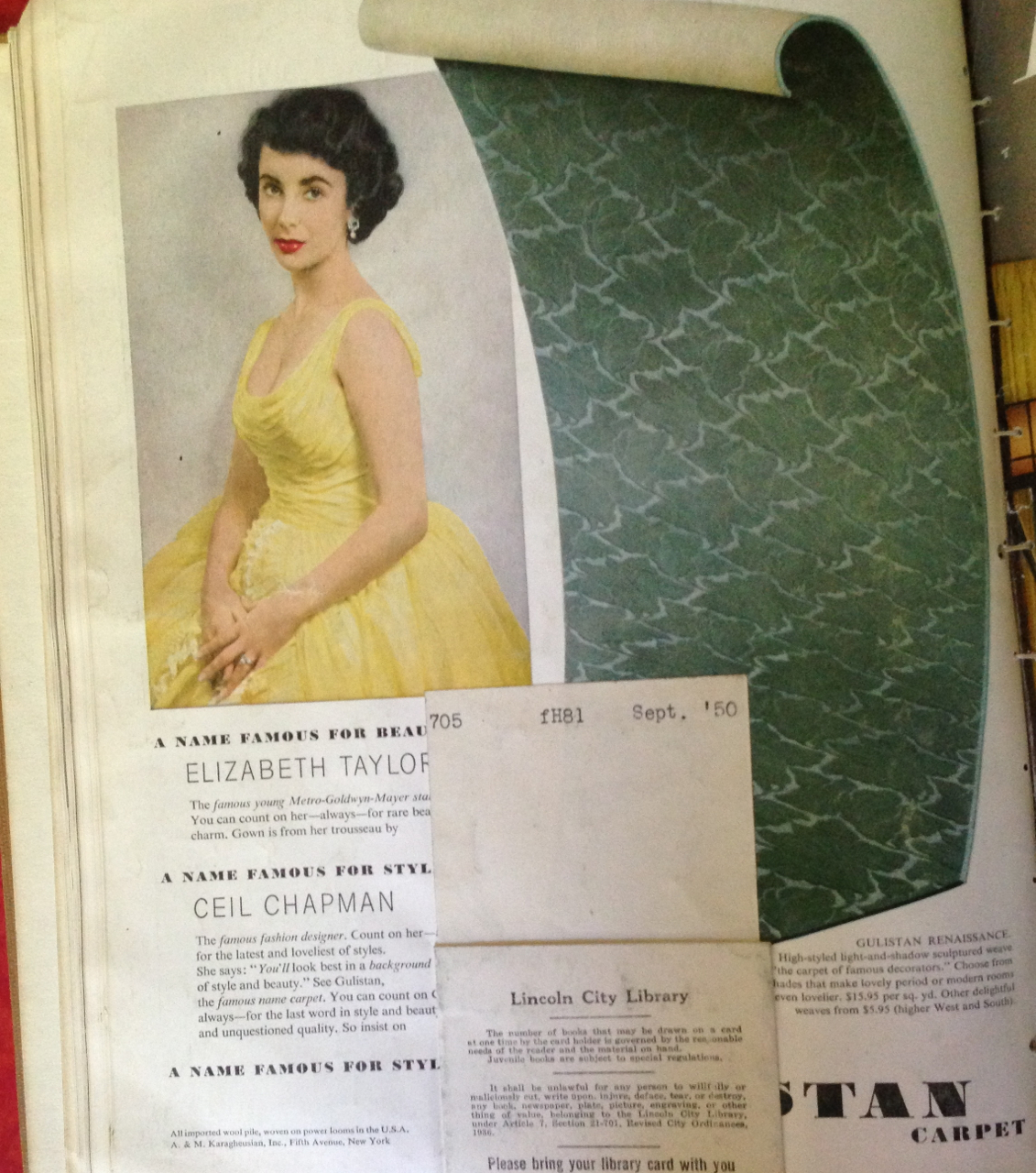
In 1950, Liz Taylor graced the back cover of the magazine, touting the luxurious carpet that Gulistan had to offer:

IMG_2063

And now?  AllState Insurance graces the back cover, presumably trying to convince you that once your house is House Beautiful, you need to sign up with them to protect all that beauty.

IMG_2062

Here are a couple ads that you just don’t see anymore in modern magazines:

IMG_2057

I swear I’m not trying to be repetitive, because I know I’ve pointed out before how you just don’t see ads for candles in modern magazines, but I guess I was struck by how many candle ads I saw in the 1950 issues.  Today?  Zero.  Back in 1950, we could also get away with copious ads for:

IMG_2071

What would Mad Men be without the liquor?  Today it seems that liquor ads are becoming more frowned-upon. I figure in a few years the liquor companies will suffer the same scorn as the tobacco industry and ads for booze will not exist.

There were a few ads in the 2013 issues of House Beautiful that you just didn’t see in 1950 and definitely reflect our changing values, especially in where our money goes.  Behold the annoying, multi-page ads for the latest prescription drugs:

IMG_2060

Two pages of ad space for this drug?  Show me the money!

While Americans certainly had debt in 1950, it wasn’t as easy to get into debt as whipping out a little plastic card and sliding it through a machine in the name of keeping up with the Joneses.

IMG_2058

The text for this ad is interesting: no late fees, no penalty rates, because there are plenty of other things to stress over.

Yeah — how about the DEBT that people are incurring on their credit cards for crap they don’t need?  That’s probably the most stressful thing of all.  Now go sit in a corner, Citibank, and count your millions.

Lastly, while many people had pets in 1950 and most certainly loved them as much as we do ours today, we definitely show them love them with food a lot more than we used to.   In 1950 there were virtually no ads for pet food, kitty litter, or anything else.  Now?  They’ve got the bucks to take out those full-page ads:

IMG_2069

Oh, and friend them on Facebook.  It’s how we roll in 2013.

Share

Movie review: Searching for Sugarman

I don’t normally do movie reviews, but I rely very heavily on reader comments on Amazon and Netflix before I watch a movie, so why not spread the word about movies I like as well?  This past weekend, while trying to find a movie to enjoy after a long day of work, I stumbled upon a movie called Searching for Sugarman.  I kept clicking past it, not thinking it looked like anything good. Who cares about where Sugarman is — whoever he is?  But then I noticed that the movie had a nearly perfect rating out of several hundred reviews.  So, I took another look.

It turns out that Sugarman is the nickname of a 1970s singer-songwriter named Rodriguez.  Never gaining popularity in the United States, his recording career fizzled out after a couple of years, even though his hippie-era music and lyrics fit right in with the Bob Dylan-type music that was so popular at the time.  Because Rodriguez was a little late to the scene is the reason that his music never took off; after all, the US had been getting a steady dose of anti-establishment hippie music for a few years and perhaps there wasn’t room for yet another peace-loving guitar strummer.

However, I think that any good singer-songwriter will find a niche eventually; it just depends on what part of the world really needs that music at that time.  Turns out that Rodriguez’s music struck a chord with apartheid-riddled South Africa.

The problem was that Rodriguez never knew that his music had sold half a million copies there.  When his career failed to take off and his label eventually dropped him, Sixto Rodriguez faded out of the tiny spotlight he was in and settled into regular life in Michigan, eventually working in the demolition business.

Fast forward twenty years … a journalist became curious about where Rodriguez had ended up after his brief career.  Part of the reason why no one had searched fro him is because the rumor mill had a fantastic story about the night that Rodriguez supposedly killed himself — in front of an audience.  For years it was passed around as true, and no one thought that the rumor may just be a bunch of crap.

So, as all good “driven journalist” stories, this one didn’t give up.  He kept digging until eventually his story about his search reached Rodriguez’s daughter, who promptly contacted the journalist, eventually leading to a phone call from the man himself.

I couldn’t help but smile as the journalist recounted the night he received a phone call from this artist.  In fact, the movie sets up the viewer to believe that the rumored on-stage suicide was really what happened to Rodriguez, and as the mystique of this man grows, so does our own curiosity.  Imagine finding out that Elvis was still alive and that he decided to give you, his biggest fan, a call to say hey.  That’s how it felt to this journalist, and his excitement comes across to the viewer at full blast.

rodriguezFinally about halfway through the documentary, we meet Rodriguez.  We first see him in dark profile, then in an interview setting.  Despite being out of the public eye for decades, the man has the “rocker” look down pat, but he comes across as extremely shy as he hides behind his dark glasses.   The documentary takes us on a journey to South Africa as he plays his first concert in over 20 years to a packed arena.  The aging songwriter, clad in black, looks every part the Johnny Cash of folk singers as he owns the stage as if he hadn’t been working a blue collar job in his “other” life.

Movie reviewer Marshall Fine (from the website Hollywood & Fine) nicely summed up the overall parallel of Rodriguez to his sudden thrust into fame that he sought 30 years before:

“And that’s the beauty of this film: that it captures the resurrection of a dream. There is something so even-tempered, almost Zen, about Rodriguez that this sudden revival of a dream deferred, while obviously gratifying and fulfilling for him as an artist, doesn’t change him as a man.”

I always enjoy documentaries that tell stories I have never heard, and this movie entertained me from beginning to end.  It’s always refreshing to hear the stories of humble people who do things not for fame and fortune but simply because they enjoy doing something.  It’s refreshing to know that for every computer-aided Barbie or Ken doll out there who is groomed to be a face rather than a true singing talent, there’s someone like Sixto Rodriguez who cancels them out, so to speak.

That’s right, Justin Bieber … I’m talkin’ to you.

Share

The spirit of neighborliness is still alive and well

I’ve written before about how it’s very easy to get up in nostalgia, forgetting the negative points of life at that time.  I think there are times when our eyes are opened to this; I know some of my friends and family experienced this first-hand in the past week after they were hit with a massive ice storm in South Dakota and many were without power for a couple of days at the least.  Some are still without power.  Some people, like my mom, enjoyed having to hunker down in the candlelight, layer on the clothing, and cook on the woodburning stove.  Others cursed as each hour of darkness went by.  However, I still saw Facebook posts about how neighbors would drop by with chainsaws (to move the huge branches that had fallen from the heavy ice coating) and car chargers for phones so that even without power, people could stay in touch with friends and family.

As I was reflecting on the thought of whether the desire to help others is a thing of the past, I ran across this letter to the “Neighbor Lady” in her 1942 cookbook (the first edition):

Hi there neighbors all.
After listening to this helpful program day after day reminds me of the close neighborly spirit of long, long ago when people, especially farmers, did and could rely on their neighbors in time of need.  Yes, in those days, even without telephones, somehow when help was needed, help came, voluntarily and generously.  This old world certainly has changed, but the people, contrary to popular belief, have that same helpful feeling toward each other now that our parents and grandparents shared between them so long ago.  Some 25 years ago I had a recipe for raisin cake that was made with one cup of bread sponge.  I have lost the recipe years ago and I wonder if one of the neighbors could help me with it.  I’d be so thankful.
Mrs. Elise Hecht
Dunnell, Minnesota


On another page, this letter appeared:

Dear neighbor lady:
This morning as I was doing my Saturday’s mopping I was listening to the radio and happened to have it turned os that I got your program.  I have heard several ladies talk about your program and what help they get from listening to you but I never had listened until this morning.  I think it is very nice to be able to help one another in this way.  I noticed one lady asked for a cake recipe which called for one cup of bread sponge and I happen to have a recipe which my mother used every time she baked bread years ago.  I hope it’s like she wants.  My sister … Mrs. Robert Huber … is a great neighbor lady fan and has had her name mentioned several times … she even won a dollar!
Mrs. Elvin Jacobsen
Woonsocket, South Dakota


Today, this spirit of neighborliness still exists online; one only has to peruse through blogs to see how people still take the time to trade recipes, ideas, hints, and advice.  What strikes me now is the time it took “back then” to be neighborly, and sometimes I think we measure our desire to be helpfulness in how many clicks of the mouse it would take in order to be helpful.  Mrs. Jacobsen, in response to Mrs. Hecht, would undoubtedly have to hand-write the recipe, place a stamp, and mail the letter.  She did it for one reason: she had a recipe that someone else wanted.  She received no monetary gain — just the notoriety that came with being published in the Neighbor Lady cookbook.

The ice storm in South Dakota — while incredibly destructive — has brought back that neighborly spirit in many cases.  I saw several posts about how meals were brought over, or home opened to friends, or yards cleaned up.  Starbucks tried to do their part by handing out free coffee to police and firefighters — which, although generous, left out two other obvious categories: paramedics and power linemen.  But what impressed me most of all were the random acts of kindness that no one had to do — they just simply did them because people knew that they were all in the same boat (or, in this case, all on the same ice-skating rink!).

It’s easy to claim that neighborliness has died simply because we get so comfortable in our everyday lives that we don’t take the time to do things that don’t directly benefit us.  The spirit is there, just as it was in 1942.  Whether it’s passing along recipes for raising cake or wielding a chain saw to clear out fallen branches, the desire to help others is alive and well; unfortunately, it takes a tragic event for that spirit to emerge.


Share

New! Improved! …. and old?

I will admit.  I am a sucker for retro design.  And yes, I have also been known to purchase products that have retro design even though I really don’t need the product.  Here’s example one.  Here’s example two, although that sack did hold a bottle of wine and I’m pretty sure I needed that.  However, I did make a point to visit one particular liquor store for that wine because I knew that they would put it in that awesome bag. So that, my friends, is how I will go out of my way to buy retro-looking products. Continue reading “New! Improved! …. and old?”

Share